Sunday, October 13, 2013

Sermon: "Remember the Good News"

Rev. Maureen Frescott
Congregational Church of Amherst, UCC
October 13, 2013
Psalm 111; 2 Timothy 2:8-15

“Remember the Good News”

In my first year of seminary, we were warned that our faith might be tested by what we learned in our classes. When we take a peek behind the curtain of Christian history and look at scripture with a critical eye, we encounter inconsistencies and uncertainties that cause some of us to question beliefs we’ve held since Sunday School.

If we grew up believing that the gospels of Matthew, Mark, Luke, and John were firsthand accounts written by Jesus’ disciples, it can be disheartening to discover that these gospels were actually written 40-80 years after Jesus’ death and most likely not by the disciples themselves.  
Even more unsettling, when we look at the gospels side by side we see that they contain discrepancies. Each presents a different image of Jesus, has conflicting details in the stories, and we find evidence that each was embellished or shaped by its author to appeal to a specific audience in a specific setting in specific time.

Looking at the gospels with a critical eye can be disheartening, yet we can reconcile these differences from a faith perspective.
As we mature in our faith we learn that the Good News is found in the message of the gospels, not in the details of the stories.
And having these four different gospel perspectives – these four different images of Jesus in light of the good news - adds richness to our faith.
But as we continue to peak behind the curtain of Christianity we may have our faith challenged once again – when we consider the Christian scribes who gave us the gospels we have today.

These scribes were monks who diligently copied the books of the New Testament in the days before we had printing presses and spell check.
For over 1400 years, these men of God worked by candlelight day and night with their quills and ink bottles, hand copying every page of the Christian scripture – approaching this tedious task as a spiritual practice just as they did when they sang the psalms or tended the monastery grounds.

But in the multitude of copies of the Gospels and Paul’s letters that have surfaced over time we find evidence that the monks were all too human.
We don’t have the original manuscripts of any books of the Bible, what we have are copies of copies of copies.
And when we compare those copies we discover mistakes - missing words, duplicated sentences, and entire paragraphs added or left out.
We run across margin notes and inline commentary made by previous scribes that were later inserted into the text as if it were the gospel truth.
And we find mistranslations and misspelled words that change the entire meaning of the text.

Some of you may have seen the cartoon that pictures a group of present day Catholic priests studying an original first century manuscript of one of Paul’s letters, suddenly one of them looks up with a horrified look on his face and shouts out:  “It says CELEBRATE not CELIBATE !"

Thankfully, as people of faith we can accept that our human fingerprints are all over our Bible, and also believe that the Gospel, the Good News that Jesus brought to us, is the Word of God and is true as it stands.

Paul reminds us in his 2nd letter to Timothy to remember the Good News – to remember Jesus Christ, raised from the dead - To look into the face of hardship and remember the new life we find in Jesus and the promise of God’s unconditional grace and love given to us all.

Paul supposedly wrote these words while he was chained to a prison wall. Like many of the early church martyrs, he managed to hold onto the optimistic promises of the gospel while facing his own inevitable death.

To have such faith may seem unfathomable to us. Many of us today take the word “gospel” and the unshakable promise it offers for granted.
For us it’s just another word we hear in church on Sunday and we have a hard time connecting it to the lives we live out there in the real world.
But when we look at the story of Paul’s life we see just how much power the Gospel contains.
The Good News took hold of Paul and transformed his life in ways that he never would have imagined…..and it has the power to do the same to ours.

Paul was born to Jewish parents in the Greek city of Tarsus.
There he was more commonly known by his Hebrew name, Saul.
He lived in the same time period as Jesus but the two never crossed paths.
Saul was a Pharisee and had been appointed as an overseer of the Jewish law.  
In the two years following Jesus’ death, Saul was especially vigilant.
If you were a follower of the Jesus movement known as “The Way”, Saul of Tarsus was not someone you wanted to run into in a dark alley… or even in the light of day.
Saul had been charged with the duty of flushing out and arresting anyone who was even suspected of being a follower of Christ. 
He listened in on conversations in the synagogues, intercepted personal letters, and was known to drag men and women out of their homes and into the streets.  Some were led off to prison, tried, and executed; others were stoned to death on the spot.

At first glance, Saul didn’t appear to be a threat. One source describes him as a man of short stature, with thinning hair, crooked legs, large knit brows, and an oversized nose.  Not exactly an intimidating presence in any era.
But Saul was an angry and violent man…and he had power, which allowed him to inflict his violent temper upon anyone he despised.

This portrait of Paul as Saul is one that stands in direct contrast to the man we Christians have come to know as the founder of the first Christian churches. The Paul we know preached about the inclusive love of God and the welcoming and saving presence of Christ. He transformed the faith by opening it up to Gentiles, declaring that in Christ there is no Jew or Greek, no slave or master, no male or female, for all are equal in the eyes of God.

Lest we forget, Paul was still a man of his time. In practice, he still supported systems of power, slavery, and patriarchy…but the message he embraced of the world that was to come was one where all these systems would be defunct.
This was a radical belief for its time.
This was the good news of Christ. The liberating message for all.

So what caused Saul to become Paul?
How did he come to experience such an extreme change of heart?

The Book of Acts and Paul’s own letters tell us about his dramatic conversion experience.
We hear of the vision of the risen Christ he had on the road to Damascus that caused him to fall on his knees and pledge allegiance to the cross and the freedom it offered through Jesus.

There aren’t many of us who can claim to have had such a dramatic conversion experience, so how might we relate to Paul’s story and the infusion of hope he felt when he heard – really heard – the Good News for the first time?

It might help us to know that Paul’s life didn’t change overnight.
It took him years to arrive at the point where we encounter him in the Pastoral letters of the New Testament.
It took him years to gain the conviction and the trust that he needed to speak of the promise of the Good News, and to have others truly listen.

Paul was a Pharisee who once dragged Christians to their death.
He had never met the living Jesus.
Yet here he was suddenly making the claim that he was an apostle in the same vein as the disciples Peter and James. He insisted that he had turned over a new leaf and no longer was a threat to the followers of the Way.
On the contrary, he had become their biggest advocate.
We can imagine that there were many who dismissed him as a fake, a pretender, or worse, a wolf hiding amongst the sheep, just waiting to strike.

But despite the opposition to who he had been and what he had done in his past, Paul continued to remember the Good News and trust the power that God had to change hearts.  The gospel had changed his own hardened heart….imagine what it could do for those who are not so far gone.


Years before I had ever dreamed of going to seminary I experienced my own change of heart.
As a lapsed Catholic I had spent 20 years searching for a new spiritual home. I truly felt lost. I was a Christian, and I longed to be a Christian in community, but as a gay woman my church shopping options were severely limited.
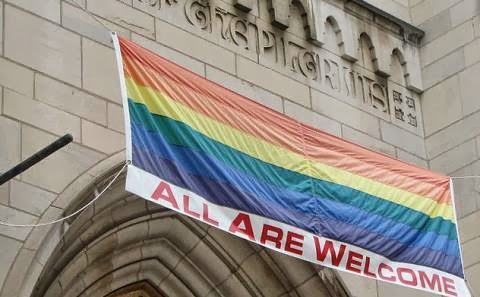
As we know, many churches say they welcome all just as Christ does, but the reality is that the welcome sign is often marked with an asterisk….and GLBT folks are among those listed in the footnotes as “unwelcome”, whether explicitly or implicitly.

And then one spring day almost ten year ago, I saw a television commercial for the United Church of Christ.
The commercial featured the tag line, “No matter who you are, or where you are on life’s journey, you are welcome here,” and it ended with a montage of images of people of diverse races, differing physical abilities, and gay and straight couples alike.
I saw that commercial and immediately I broke down crying.
I never dreamed that such a church existed.
Here was a Christian church that would welcome me as I am.  Explicitly.
This was my Good News.
The news that broke my heart wide open and brought me down on my knees before God.

The Good News is that God loves us all unconditionally.
Even when we feel unlovable.
Even when we fail miserably.
Even when we can’t stop crying, or shouting, or holding it all inside.
God loves us when we feel messed up and stressed out.
God loves us when we keep walking down the same road that leads us straight into trouble.
God loves us when we’re mean to each other and when we’re cranky.
God loves us even before we’ve had our first cup of coffee, as writer Anne Lamott so aptly puts it.

The gospel – the good news – is what reaches down into the hole we’ve fallen into and tells us that we’re not alone.
The good news is what gives us the strength to reach into the holes that others have fallen in and let them know they’re not alone as well.

But as Paul demonstrates, the good news is not meant to be a feel-good pill that takes our troubles away.
Often remembering the gospel involves hard, hard work.
It pulls us towards change.
It pushes us outside of our comfort zone.
It urges us to take risks.
It prods us to confront ideologies, systems, and people who stand in opposition to what we believe in our heart of hearts to be true and just.

Sometimes when we remember the gospel we end up like Paul.
Shouted down, run out of town, thrown in prison.
But remembering the gospel doesn’t have to be about picking up a protest sign, or preaching on a street corner, or confronting the people in power to change….although a big part of it is.
Remembering the gospel also involves much more personal and everyday choices.

We remember the gospel when we grudgingly show patience with a family member or coworker who knows just what button to push to send us spinning off kilter.

We remember the gospel when we encounter people whom we deem as being beneath us – socially, economically, culturally – and look them in the eye and call them by name, treating them as a child of God just as we are.

We remember the gospel when we put items in our grocery cart to donate to the local food pantry, even though our own cash flow is tight or uncertain for the future.

We remember the gospel when we listen with an open heart to someone who stands on the opposite end of the spectrum to us ideologically and politically, and seek to understand the passion, desire, and fear behind their words….and in turn recognize how OUR words are likewise rooted in our own passions, desires, and fears.

Remembering the gospel is about taking the unconditional love that God gives to us, and spreading it around so that others may feel it as well.

Have you heard the Good News?
It will change your life….God guarantees it, for us all.  

Amen.


Sunday, September 22, 2013

Sermon: "Is There a Doctor in the House?"

Rev. Maureen Frescott
Congregational Church of Amherst, UCC
September 22, 2013
Psalm 79:1-9; Jeremiah 8:18-9:1

“Is There a Doctor in the House?

The Balm of Gilead was a healing compound made from the resinous gum of a bush which grew plentifully in the area of Gilead during biblical times.
The sticky balm was thought to cure a whole host of ailments, from skin diseases to headaches to easing the pain of broken limbs.

We may snicker at the simplistic remedies of ancient times, but I wonder how many of you are familiar with a product called BAG BALM.
Bag Balm is an ointment developed in VT in 1899 by a dairy farmer.
The farmers rubbed it on the udders of their cows to soothe irritation after milking.  When the farmers' wives began noticing the softness of their husbands' hands, they started using the product themselves. Today, Bag Balm can be found in drug stores, ski resorts, and of course farm and feed stores, as it’s still regulated by the FDA for use only on animals. It’s used to soothe psoriasis, dry skin, cracked fingers, burns, acne, diaper rash, bed sores, sunburn, tattoos, and even pruned trees. It’s also used to lubricate rifles, shell casings, and squeaky bed springs.

Basically, Bag Balm is the duct tape of medicine.
It comes in a 10-ounce green square tin with a cow's head on the lid.
The packaging, and the balm, have remained unchanged since 1899.
Further proof that there are some sources of healing that withstand the test of time.

After hearing our two scripture readings this morning, we may be asking ourselves if there is a balm in Gilead.  
Between the Psalmist’s lament and Jeremiah’s tears, we may be left wondering, “Where is the Good News?”
How did these people find healing in the midst of such despair?
This can happen when we hear passages without knowing their full context.
We find that we’ve stepped into the midst of an ancient people’s pain with a limited understanding of where it’s coming from.
The truth is, there’s a lot of pain present in scripture.
About 1/3 of the Psalms in our Bible are categorized as Psalms of lament.
Laments are just as the word describes – a passionate expression of grief or sorrow.

For some of us, the last thing we want to hear in church on Sunday morning is a lament. We have enough grief and sorrow in our lives, and we come here to find a soothing balm and a clean dressing for our open wounds – an infusion of hope, that will help us to go back into the world with a little extra padding between us and our pain.

Even if we’re not experiencing a personal sorrow at this time, the Psalmist laments can be difficult for us to hear.
When we read Psalms that call on God to pour out anger and destruction upon nations for the wrongs they have commited, we get dismissive.
This is not the God that most of us worship - This God of vengeance and judgment who smites entire peoples for their transgressions.

But let us not confuse the words and actions of God with the words and actions of a people in pain.
The scripture texts we heard this morning are the words of a people trying to understand the role that God plays in the world.
Amidst war and destruction, they can’t help but ask,
“How is it that our enemies have overrun us when God has promised to protect us?”
“How is it that worshiping God seems to do little to alleviate our suffering?”

Jeremiah calls out to God, and asks, “Is there a balm in Gilead? Is there no physician here to restore us to health and ease our pain?”
The people of Judah were in desperate need of a balm, a soothing remedy to heal their wounds.

When Jeremiah was a young man a new king came to power.
King Josiah.
One of the first things that Josiah did was renovate the Temple in Jerusalem; to return it to the glory it had known before the Assyrian invasion.
During the renovation of the Temple, workers discovered a book hidden in the recesses of the walls. It was the book of Deuteronomy. 
Believed to have been written by Moses himself, the book contained a detailed institutional code: Laws governing worship, the appointment and regulation of religious leaders, and blessings and curses for those who keep and break the law.

Using Deuteronomy as his guide, Josiah banned the worship of all other Gods, reinstated the celebration of the Passover, and launched a program of religious reform that made the Temple the center of all Jewish life.
Local shrines were closed and the people were required to bring their offerings to the Temple in Jerusalem. Only the priests who practiced in Jerusalem now had the power to absolve sins.

There is an interesting sidebar to this story.
There is an earnest debate among modern scholars over how much of the discovered book of Deuteronomy was original and how much of it was amended by Josiah and the Temple Priests. It is curious that the “discovery” of the written code during the Temple renovation conveniently moved all power to the Temple priests and provided a scriptural basis for the reforms that Josiah had already begun putting into place.
God is still speaking indeed.

Regardless of how the reforms came about, the result was that Judaism became centered and strengthened by the elevation of the importance of the Temple and Temple worship.
And then King Josiah was killed in battle.
A new King came to power. One who did not value the reforms that Josiah had put into place. The new king was not as attentive or as passionate about managing the Temple. The priests and the people became content with going through the motions of ritual and sacrifice and saw no need to demand more of themselves in the service of God.
When the threat of outside invasion returned to Judah, the people blamed God for abandoning them, and the hollow rituals of the Temple provided little balm to soothe their pain.

It is in this atmosphere of an ineffective Temple and a weakened spiritual resilience that Jeremiah offered up the lament that we heard in our scripture reading today.

By following the letter of the law without nurturing the spirit of the law, the Temple and the people were ill equipped to handle the challenges and the unrest of their time.

Some would say that we are in a similar situation in our own time.

With the ranks of the religiously unaffiliated growing year by year, we wonder if the message of Christianity has lost its appeal.
The institutional church is no longer seen as the place to find healing in a hurting world.
The people are asking, “Is there a balm in Gilead? Is there a doctor among us who can restore us to health?”
And while we in the church wring our hands trying to figure out how to pay our utility bills, the people continue to seek that healing balm elsewhere.
In work and busyness, in money and material goods, in pharmaceuticals and fad diets, in addictive pleasures and distractions.

The lament that we raise as modern day believers is worthy of its own Psalm.
“What must we do, oh Lord, to bring healing to our hurting world?”


When Jesus was walking the roads of Palestine, people flocked to him because he had the power to heal whatever ailed them…whether it was withered limbs or hemorrhaging bodies. But more importantly, Jesus had the power to heal their withered and hemorrhaging spirits.  
He spoke of a loving and forgiving God who welcomed all, and his words were like a soothing balm spread upon dried and cracked skin.

When the apostle Paul took the message of Jesus and set up house churches in towns and cities far and wide, Jews and Gentiles alike poked their heads through the doorways to see what the fuss was all about.
Some walked away thinking he was just another charlatan selling snake oil, but others stayed to listen, and found healing they had not expected to find.

Over the course of 2,000 years the church has repackaged and refurbished Jesus message to speak to the needs of hurting people in all ages and all corners of the world.  Jesus is a balm that has withstood the test of time.

How is that the words of this first century Palestinian Jew have resonated with so many – Greek philosophers, medieval peasants, renaissance artists, stoic Puritans, African slaves, civil rights marchers, immigrants, refugees, and people of all times and places who’ve sought the liberating love of God. 
And how is it that those same words of liberation have resonated with Kings, wealthy business owners, and white middle and upper class Americans whose lives are far removed from the suffering experienced by so many?

Because regardless of our life circumstances, we’re all human beings.
We all experience pain – the pain of loss, grief, and despair.
And we all experience joy -  the joy of creation, compassion, and love.

Being a part of a spiritual community is the primary way human beings throughout the ages have sought to express their joy and heal their pain, and I don’t expect that to change anytime soon.
Our challenge as a church in the 21st century is to envision the ways that we might be the healing balm that the people of our time are seeking.

How might we find meaning in the context of our faith communities?
How might we use tradition and ritual AND creativity and innovation to both anchor and liberate the next generation of believers? 
How might we take a page out of Paul’s book and encourage people to poke their heads through our doorways to see what the fuss is all about, and hopefully have them stay to find unexpected healing?

Perhaps we could start where Jesus and the original disciples did.
In the gathering of community, nurturing our faith through prayer, reflection, and worship.
And out on the street, serving others and living our faith in the world.
As the body of Christ we’re called to both receive and offer the balm of healing.

The church is meant to be a sanctuary – a place where we come to find respite from our busy lives, to find communion with God and other people, to share our joys and shed our burdens, and to discover the gifts that we have to give to the world.

And the church is meant to be a prophetic presence – challenging the status quo, speaking out against injustice, demanding sacrifices of each of us so that all might share in God’s bounty, and moving against the grain of a culture that elevates consumerism, nationalism, and individualism above God and our call to be the body of Christ in the world.

There is a balm in Gilead.
To make the wounded whole
There is a balm in Gilead
To heal the sin-sick soul

The Good News is that the laments of Jeremiah and the Psalmist did not fall on deaf ears. 

As author Brian McLaren writes:

The good news is that God loves the world and didn’t send Jesus to condemn it but to save it; the good news is that God’s wrath is not merely punitive but restorative; the good news is that the fire of God’s holiness is not bent on eternal torment but always works to purify and refine; the good news is that where sin abounds, grace abounds all the more.

What pain are you hoping to have soothed by coming here today?
What pain is the person seated beside you carrying with them?
How might we come to understand and be a healing presence for one another?

Might we let God in, to make our wounded world whole.

Amen.


Sunday, September 1, 2013

Sermon: "A Slice of Humble Pie"

Rev. Maureen Frescott
The Congregational Church of Amherst, UCC
September 1, 2013
Hebrews 13:1-8,15-16; Luke 14:1, 7-14

“A Slice of Humble Pie”


When I was 17-years-old, I got my first job working at a bike shop on Long Island.
I worked at the parts and accessories counter ringing up sales at the cash register and helping customers who needed bicycle tubes and water bottles.
I loved cycling, and gradually I worked my way up to helping out in the stock room, ordering parts, and in my mid-20’s I became manager and buyer for the entire department.
It was a large and busy shop, and every year we hired a new crop of high school students to work the counters and the cash registers, just as I did when I started.
This was a tough job, as some of our customers came in with technical questions or specific requests and quickly lost patience when met with a dumbfounded stare from the 16-year-old behind the counter.

I remember one customer in particular who came in looking for a part for a 1935 Schwinn. He gave a detailed description of the part to Katie, the young girl working the counter. Katie yelled out, “Hey Mo!” (which is what most people in the shop called me) and she ran into the back room where I was busy writing up purchase orders. She relayed the customers’ request and I knew right away that the part was no longer available.

Katie returned to the counter and told the customer, “I’m sorry, but Mo says we can’t get the part.”  This answer was not acceptable to him.
Again, the man launched into a detailed description of the part he wanted, convinced that this young girl had misunderstood him.

Katie came back to me, this time rolling her eyes, and I told her again that, no, we don’t have what he’s looking for.
She went out and told the customer a second time, “Mo says we can’t get the part.”
With his anger rising the man sent poor Katie back to me two more times asking for the same part, until he finally said to her what he wanted to say all along, “Why am I talking to you? No offense, but girls don’t know anything about bicycles! I want to speak to the guy who runs this department. I want to speak to Mo. He’ll know what I’m talking about.”

When I emerged from the back room the man was quite surprised.

This man had dismissed Katie as not being worthy of his time, patience, or respect, because she was young and female.

This came as no surprise to me, because in the years that I spent working the counter I too had many customers tell me right to my face that I couldn’t possibly know what I was talking about because I was just a girl.

Anyone who works in a field where one is atypical of the norm knows what it’s like to have one’s knowledge, competency, and authority questioned - whether you’re a female in a male dominated profession, or you have black or brown skin in world where those with white skin hold most of the power, or you’re a person with a disability trying to function and flourish in an environment that was designed by and for someone other than you.

Regardless of who we are or where we sit in the pecking order of society, many of us carry a painful memory of a time when we felt dismissed, belittled, or pushed aside because we were deemed unworthy of the respect or recognition of others - because we were too young, came from the wrong side of town, went to the wrong school, or were too inexperienced to gain a seat at the table.
As we’ve heard, Jesus had a lot to say about seating arrangements at the table.

Our gospel story finds him attending a Sabbath meal at the home of one the Pharisees leaders when he takes notice of how the guests are choosing their seats.

Some come in hesitantly and choose seats on the far ends, knowing that those who are more important will expect to have the seats closest to the host.
Others come in confidently and take seats right next to the host, believing that no one else in attendance will outrank them in importance, and even if someone does, this is a way to usurp that power by claiming it as their own.

I imagine that others still were reluctant to choose any seat until all the guests had arrived. Choosing instead to mill about with their drinks in hand waiting to see how everyone else sorted themselves out.

As evolved as we’ve become as a species, we’re not very far from our primate predecessors who arranged their social structure according to body size, power, and ability to intimidate. 
In a world where resources are limited and controlled by a very few, it’s natural that there is a constant jockeying for position amongst those who want access to those resources.
The table has always been a scene of contention.

I can imagine Jesus making the same observations in our time, at wedding receptions, political fundraisers, and even in our school cafeterias, where it doesn’t take much of an observing eye to sort out who has the seats of honor, and who does not. When it comes to power struggles, a Pharisee banquet has nothing on a middle school lunch period.

What we learn from this gospel passage is that God expects more from us.
God expects us to put our egos and our own desires for recognition and power aside, and to humble ourselves in each other’s presence.
We are to choose the lowest positions at the table, and leave it up to our host to decide whether we should be honored with a higher placing.

Notice that in the telling of this parable Jesus doesn’t end it by saying the guests all joined hands around the table as equals and sang “Kumbaya.”
That is the ideal - the utopia that we’ll experience in the coming Kingdom of God.
But we’re not there yet.

In this world Jesus acknowledges that there are hosts and honored guests. There are wedding banquets where the rich and the powerful are invited for the simple reason that the one doing the inviting hopes that their guests will reciprocate….and then there are the poor, the blind and the lame – the powerless – who need to know that they too are welcome and expected at God’s table, even if calls for us to sacrifice our own standing to ensure that they are included.

Jesus calls us to keep our pride and our egos in check – to love kindness, to act justly, and to walk humbly with our God.
But as with many things that Jesus asks of us, this is very hard to do.

This morning, we wrestle with this call to peaceful humility in the shadow of God’s table in a week that has us on the brink of possible military action in Syria – where we as a country may choose to step into the midst of a civil war so complex and so dire that there is no moral or noble choice that leaps out above the other.  
Either way, people are going to die…
….and the world will weep and God will weep along with us.

This table is too messy and too contentious for those of us with peaceful and humble hearts to even consider approaching.      But what will become of those who stand to be trampled underfoot if we do not?

This morning, we wrestle with this call to peaceful humility in the shadow of God’s table in a week where one humble woman stared down the barrel of a gun and chose not to respond with fear.
Antoinette Tuff relied on the power of persuasion and love, when 20-year-old Michael Hill walked into her elementary school in Decatur, Georgia, with an assault rifle, 500 rounds of ammunition and "nothing to live for". 
Antoinette invited Michael to the table. 
She told him that he had value in God’s eyes and there was another way for him to find peace in his turbulent world. She looked into his eyes and didn’t see a crazed gunman or a soulless demon. She saw a young man aching for love and inclusion. She saw the sick, the lame, the marginalized and she invited him to God’s banquet, expecting nothing in return.  

When we think of the atrocities of Syria and the extreme bravery of Antoinette Tuff, it may seem silly and petty for us to devote time and energy worrying about the seating arrangements at our own meager banquet tables…..as we become anxious over who among us makes more money, who has a nicer house or car, and whose child has more AP classes or gets more playing time on the school team.

But all table squabbles are relative.
Big or small they have the power to consume our lives if we don’t heed Jesus’ advice and take a step back, take a deep breath, and humble ourselves by taking the lowest place at the table.

Translating this teaching into action in the real world is not easy by any means.
The world we live in is full of striations, delineations, and hierarchical organizations that force us to rank people according to an increasing and decreasing scale of importance. 
We all have somebody above us, and we all have somebody below us, and attempting to transpose our Christian values of equality on a system that is built on inequality is fraught with difficulties.

But it can be done.
The recently elected Pope Francis has made headlines by shunning the ornate thrones and deluxe accommodations enjoyed by previous Popes, but he is still the Pope.
He still sits above all others in the Catholic Church and is surrounded by the wealth and power that the office bestows upon him.
Yet he chooses not to partake in much of it. Instead he chooses to walk to work, to sit in the back row when he worships in the Vatican chapel, and to wash the feet of the poor and disenfranchised just as he did as a cardinal and as a priest.  

As he continues to speak out against the devaluation of women and for the inclusion of gays and lesbians in the Church, I expect that Pope Francis will find even more creative ways to use the power of his office to put himself in the lower seat so that others may find a more honored place at the table.

We are called to do the same with the power that we possess, however small it is.

The author of the epistle to the Hebrews writes:
 “Do not neglect to show hospitality to strangers, for by doing so some have entertained angels without knowing it.”  (13:2)

By taking that lower seat we lift someone else up.
By inviting the marginalized to the banquet, we show hospitality to strangers.
In both cases we invite the love of God into our relationships and our interactions in the world. We entertain angels without knowing it.

Which is why we’re called to relate to every person as if they were Christ in our midst.
We never know where or when we’re going to encounter Christ in our world.

We may encounter Christ in the 16-year-old store clerk who is not skilled or knowledgeable enough to serve us in the way that we’re accustomed to being served.
Or in the man that we choose not to befriend because he wears a blue collar to work, rather than a white collar.
Or in the woman we see shopping at Walmart who has too many kids, is committing too many fashion faux pas, and whose cart is too full of junk food for our liking.

We may strain to see Christ in someone who doesn’t fit our image of where God might choose to dwell. But God is there nonetheless.

Because God dwells in the hearts of each one of us.
Despite our faults and our foibles, despite the fact that we can be egotistical, judgmental, and downright nasty to each other at times.
God loves us and works through us even when we’re at our worst.
Because God knows what we’re capable of when we’re at our best.

In the coming week, in the face of our worldly concerns, big and small,
might we do our best to love kindness, act justly, and walk humbly with our God.

We just might be surprised at how much power we have when we do so.

Amen.


Wednesday, August 21, 2013

Sermon: "Faith In Things Not Seen"

The Rev. Maureen Frescott
Congregational Church of Amherst, UCC
August 11, 2013
Hebrews 11:1-3, 8-16; Luke 12:32-40

“Faith In Things Not Seen”


Once upon a time our world was flat.
A dome of water surrounded the earth above and below, and Heaven was up and Hell was down. Over time we began to recognize that the earth was not flat but round, but we still believed that the sun rose and set by God’s hand and we as God’s creation sat solidly at the center of the universe….until a man named Copernicus looked up the sky and saw it differently.

Through his observations of the seasons and shadows, Copernicus concluded that the sun, and not the earth, belonged at the center.
Perhaps sensing the trouble that this reversal of roles would cause, Copernicus waited until just before his death to publish his findings.
 When he did, Catholics and Protestants were equally perturbed.
The Roman Church claimed that Copernicus held no authority over God, and Martin Luther simply called him a fool.

A half a century later, Galileo peered at the night sky through his homemade telescope and concluded that Copernicus was right.
But unlike Copernicus, Galileo did not scribble in his notebook and tuck it safely away for a later date, instead he ran to the Pope with the news of his discovery, eager to share what God had revealed.
We all know what happened next.
Galileo was summoned before the Inquisition and ordered to renounce his findings.
In his defense, Galileo quoted the words of Cardinal Baronio, who said,
 “The Bible tells us how to go to heaven, not how the heavens go.”
But Galileo’s inquisitors were not moved.

On June 22, 1633, at the age of 70, Galileo knelt down on a hard marble floor in Rome and read the renunciation that had been written for him:
With sincere heart and unfeigned faith I do damn and detest the said errors and heresies contrary to the Holy Church, and I do swear for the future that I will never again speak or write such things as might bring me under similar suspicion.

Galileo spent the last eight years of his life under house arrest, reading the seven daily psalms of penitence that were a part of his sentence, and sitting by the window with his telescope, watching the heavens move overhead by its own will, ignoring the will of those who wished to shade it in darkness.

Galileo’s story is but one example of how human beings can look at the same night sky and see very different things.
Some look at it through the lens of faith and mystery and see it as an uncharted playground that God has laid out before us to map and explore.
Others look at it through the lens of belief and tradition and declare it as unapproachable and unmovable by our desire to change what has always been.

Faith and belief are unavoidably intertwined, but while we often use the terms interchangeably in can be argued that they are not the same.

In a religious sense, BELIEF can be defined as an intellectual assent to a particular set of theological convictions that guide us and anchor us in tradition, whereas FAITH can be defined as an “unreserved opening of the mind to the truth, whatever it may turn out to be.”

Belief tethers us to what has been.
Faith opens us up to the possibility of what might be.

The unknown sermon writer who penned the words to the Hebrews, tells us that faith is the assurance of things hoped for, the conviction of things not seen.
This is what makes faith much harder to understand and explain, especially for those who feel that they lack faith or say that they have no need for it.
For those of us who claim to have faith, its lack of concrete terminology is what makes it so much harder for us to talk about amongst ourselves.
Often it’s much easier for us to talk about what we believe, and why we believe - rather than talk about how our faith is expressed in our lives – how it informs our actions, how it has changed our life, how it keeps calling us to move outside of our comfort zone to do things that we never in a million years could imagine doing without it.

Faith is the conviction of things not seen, but the results of faith often can be seen.
We see it where the hungry are fed, the sick are cared for, the oppressed are set free, and the ostracized are welcomed with open arms.
In this regard, the expression of faith has very little to do with memorizing scripture verses, reciting creeds, or following a set a rules that we believe will guarantee our entrance into the kingdom of God.
In fact, our gospel reading today assures us that is not belief but faith that will open our eyes to the gifts that God has to offer.

Jesus told his disciples, “Do not be afraid, little flock, for it is your Father’s good pleasure to give you the kingdom.”
All you have to do is be prepared – and be open to receiving it.

As long as we have faith that the kingdom of God – the reign of God - where all will receive equally from the abundance of God’s creation – is real and attainable by each and every one of us, this is all that we need to see it into existence.

The beliefs that we hold about how we get in and who gets in are of our own creation and ultimately shield us from grasping the true breadth of God.
Expressed in this way, belief can actually be a hindrance to faith.

Conversely, faith that has no connection to belief can be just as hollow.
It’s our belief, the stories that we tell about ourselves - how we got here, and why we’re here - that add meaning to our lives.
But when we focus too much on the details of the stories and insist that they must be true with a small T in order to be true with a capital T – then we’re in danger of missing the point.

According to one Native American creation myth, our entire world rests on the back of a giant turtle.
An ethnologist who was attempting to record the story for a research paper asked a tribal elder what was underneath the turtle, and the elder said, “Another turtle.”
To which the ethnologist replied, “And what’s under that?”
The elder replied, “Another turtle.”
Showing his frustration, the ethnologist, said, “But what’s under that, what’s holding the whole structure up?”
And the elder said, “I assure you, sir, it’s turtles all the way down.”

We may laugh, but the story of the earth existing on the back of an infinite number of turtles is no more ludicrous than our own image of an eternal anthropomorphic God gathering dust into his hands, breathing life into it and creating a world teaming with trees, birds, sea creatures, and human beings.

This is how we make meaning of our world.
In belief we find meaning.
But the danger of weaving our beliefs too tightly with our faith is if we tug on one thread and pull it loose the whole thing is in danger of unraveling.

This is how some of us end up turning our backs on God when we discover that the details of the stories and the “facts” of our tradition may not necessarily be true. We begin to question not just our beliefs, but our faith as well.

But surprisingly, if we look at the stories of our Judeo-Christian tradition, we’ll see that God is rarely open to being hemmed in by our expectations and beliefs.

As the Rev. Barbara Brown Taylor puts it:
“The Bible is one long story about how God demolishes human beliefs in order to clear space for faith.”
Abraham and Sara believe that they are too old to bear a child and God sends them Isaac as a surprising gift.
Elijah believes that God’s voice will come thundering out of the heavens and he hears it in the silence instead. Paul believes he’s doing God’s work by dragging Christians into the streets to be killed and God knocks him flat on his back and fills him with the love of Christ.

When we take the stories that God inspired us to create about ourselves and our origins and turn them into irrefutable beliefs then we run the risk of losing the gift of these stories when those beliefs no longer ring true.
It is faith that allows us to hold onto and celebrate these stories of our tradition even if we no longer believe them to be factually true.

In belief we find meaning.
We find meaning in the story of unmarried pregnant teenager who is unshaken by the fact that she is young, poor, female, and powerless. Instead she defies those who dismiss her and says, “Yes” to giving birth to God.

We find meaning in the story of a God who chooses to be born into flesh – into poverty, into pain, into vulnerability, and into a world that was woefully unprepared to hear a message about God’s radically inclusive love and mercy.

We find meaning in the story of a man from Nazareth who turns the other cheek, prays for those who persecute him, loves his neighbor and his enemy as himself, and demands that the last will be first and the first will be last. A man so dangerous to so many that there was no other way for the story to end but with his long and tortured death.

But the story didn’t end there.
And we find meaning in the resurrection, the rising from the earth, the message that fear never, NEVER, conquers Love.

In all this we find meaning.
But this alone is not our faith.
Our faith exists beyond the details of these stories.

From a faith perspective it doesn’t matter if Mary was not really a virgin, or if Jesus never said he was the Messiah, or if God created the world over the course of 4 billion years rather than 6 days. What matters is that Mary loved, Jesus lived, and God created.

Belief is found in the details of the story.
Faith is found in the message of the story.

One compliments the other, and neither should stand on it’s own.

Galileo was forced to recant his revelation on his knees to preserve the beliefs of his time, but his faith in God as one who invites us to see things in new ways never left him, as he continued to point his telescope towards the sky.

Whether the subject is science or religion, if we’re as open to the world as God calls us to be our beliefs can’t help but be challenged by our experience, which begs us to never put a lid on the truth. To never place a period where God has placed a comma, as Gracie Allen was so fond of saying. To remain keenly aware of how we feel threatened or fearful when our beliefs are challenged and to ask ourselves what is more important to us -  preserving the belief, or allowing ourselves to be changed by the presence of God.

Once upon at time our world was flat.
And then we looked up at the sky and realized that it was more then it we ever imagined it to be.
Once upon a time we named God as our Creator.
And we looked at God and each other and realized that we can be more then we ever imagined we could be.
The story of faith, our story, is still being written, and it is so much more than we can ever imagine it to be.
Thanks be to God!

Amen.


Sunday, August 4, 2013

Sermon: "Bonfire of the Vanities"

Rev. Maureen Frescott
Congregational Church of Amherst, UCC
August 4, 2013
Ecclesiastes 1:2, 12-14; 2:18-23; Luke 12:13-21

“Bonfire of the Vanities”

There’s an old story about a stingy old rich man who was bedridden in his final days. He had heard the saying, “You can’t take it with you,” and was determined to prove it wrong.

He instructed his wife to go to the bank and withdraw enough money to fill two pillowcases.
He then told her to take the bags of money to the attic and leave them directly above his bed. His plan? When he passed away, he would reach out and grab the bags on his way to heaven.

Several weeks after the man died, his wife was up in the attic cleaning, when she came upon the two forgotten pillowcases stuffed with cash.
“Oh, that darned old fool,” she exclaimed. “I knew I should have put the money in the basement.”

The message of both of our scripture passages this morning is that we can’t take it with us.  
Anyone who has ever moved, downsized to a smaller living space, or inherited a household worth of stuff after the death of a parent, knows this.
All that we work so hard to accumulate in this life will be left behind – left as a joy or burden to our families, to gather dust in someone else’s attic, or to gradually decay, rust, and be reclaimed to the earth by the ravages of time.
Nothing in this world lasts forever.

Jesus has much to say about putting undue value on things that are in reality, temporary and worth much less than we think they are.
The Parable of the Rich Fool is a signature Jesus parable in this regard.

Now, any time a rich man talks to Jesus or asks him a question we know it’s not going to end well.  As I said earlier in our introduction to the gospel reading, Luke in particular loved pairing the words “rich” and “fool” together.

The gospels are full of tales of rich men hoarding their possessions and not getting into heaven, widows giving their last nickel to the church while the rich give very little, money changers having their tables overturned, and greedy land owners not paying a fair wage.

But while the rich are the focus if all of these stories, what Jesus is lifting up here is not the evil of having money and possessions, but rather the evils that result when we place too much value upon them.  
The focus of these stories is greed.

The rich man in our parable today is looking for a way to store his crops for future use. His concern is that without a larger barn to store his goods, he will not feel secure enough to relax and enjoy life.

And we might ask, what’s wrong with that?
The man has done nothing illegal to gain his bounty. He didn’t steal it, he didn’t manipulate anyone into giving it to him, and there is no mention of him not treating his workers well or tying to cheat anyone out of a fair wage. His land produces a bountiful crop. The soil, sun and rain worked together to make him a rich man. He simply builds bigger barns to hold what he rightfully harvested from his land.
Would it be better for him to let it go to waste?

We might answer that what God has given us is not for us to hold onto for ourselves. The man should give the excess back to God, by giving it to those in his community who have less.
But perhaps the message that Jesus has for us here goes a bit deeper than our need to give back to God.  It’s hard for us to pour out God’s love if we haven’t made room to receive it.

The man’s life has been taken over with worry and concern over how to store his possessions. He believes that he cannot relax into the joy of living as long as his future is insecure. He does not acknowledge the gift that God has given him and he does not trust that God will continue to provide.

In a world ravaged by drought, floods, unstable economies, and food insecurity, many of us might have cause to doubt that “God will provide” as well.
When children in our own communities go to bed hungry at night and families have to choose between rent and groceries, telling them that God will provide may not be enough to keep them from imagining how they might build their own bigger barn, to ensure they have enough to feel secure.

When I was in seminary, I traveled to Kentucky with twelve of my classmates to learn how poverty affected children living in the poorest parts of Appalachia.
We visited a church that gathered as a community every Thursday night to pack bags full of food to be given to local schoolchildren.  During the week these children relied on the free meals offered at school and would often go hungry for the 68 hours between Friday afternoon and Monday morning.  What was striking is that the children receiving the food bags were instructed to hide the bags from their parents, as too often the food was taken away from the children, hoarded for another day, or sold to fund a parent’s addiction.

Greed is fed by insecurity and fear.
It is not limited to one socioeconomic class and it comes in many forms.
We might place undue value on our possessions, the size of the land that we own, the number of people under our influence, and our ability to exert power over others.
Greed also comes into play when we withhold our time, attention, respect, and love from those whom we deem unworthy of receiving it.

Jesus sees and calls out the fear that is at the root of our greed.
Our fear of not having enough.
Our fear that we are powerless.
Our fear that we ourselves are unworthy of love.
But too often what we desire, what we long to possess, what we hoard because without it we feel insecure, is something that is perishable and temporary, and once it’s gone we fall into fear yet again.


The author of Ecclesiastes writes,
Vanity of vanities! All is vanity.
I saw all the deeds that are done under the sun; and see, all is vanity   and a chasing after wind.

When we hear this text, our modern ears translate the word vanity as meaning self-centeredness, narcissism, or pride.
But the root of the word vanity is emptiness.
In fact, the word that appears in the original Hebrew text is hevel,
  which means “breath, vapor, impermanence” –
Hevel is a fleeting vaporous apparition that is easily blown away.

Perhaps this text from Ecclesiastes is better read as:
“Vapor of vapors. All is vapor. All the deeds that are done under the sun are vapor, and a chasing after wind.”

Now we might argue that we accept that our material possessions are fleeting and temporary, but our work – all the deeds and toil that we’ve done under the sun – are not.
What we do now has the power to affect generations to come – socially, economically, environmentally, and spiritually; and while our human legacies will not live on for eternity, there is still value in what we create and leave behind for future generations.
All is not vanity. All is not empty.
All is not foolish toil left to wither under the sun.

But perhaps too much of it is.

If we all took out a sheet of paper and listed everything that we do in a typical week, we might be forced to defend the necessity of a good number of things on the list.
Work is necessary. Play is necessary. Time spent with family and friends is necessary. As members of a church community, we might add that time spent serving others and serving God, is necessary.

But how much is too much?
How far can we stretch the reasoning, the rationalization, for the necessity of every thing that we do?

The average adult in our society leads an increasingly overscheduled life, add a couple of kids to the mix, and one’s life quickly becomes an endless parade of lacrosse practices, soccer games, dance recitals, violin lessons, doctors appointments, teacher meetings, and school assemblies.
Even without school age children, when we string together work commitments, plans with friends, trips to the gym, caring for adult children or elderly parents, and various boards, committees, and organizations that we choose to serve, we quickly see why the mantra of our modern world has become, “I’d love to, but I have no time.”

Earlier this week I saw a posting on facebook that read,
        “Stop the glorification of BUSY!”

Too often we wear our busyness as a badge of honor.
As we list all those things that we do in a typical week, we may feel a sense of pride in what we’ve managed to accomplish.
Our busyness can add to our sense of importance and value, to the point that when a friend asks us how we’re doing and we respond with a breathless rundown of all the things we’ve done, and still have yet to do – perhaps we’re not complaining so much as bragging.

For many of us, beneath the feeling that we’re exhausted, overworked, and overstressed, is the fear that if we don’t have a full schedule, we will cease to have value….or will be thought of as unimportant.
We worry that our kids will fail to keep up with those who have a multitude of extracurricular activities to add to their college applications.
Or we believe that we are too important to lessen our pace.

We imagine all that would fall through the cracks and ask ourselves,
“What would the people at work do without me?”
“What would my family do without me?”
“What would my church – and God – do without me?”

What is so wonderful about our scripture texts today is that they both give us good reason to yank ourselves off the treadmill that we’re struggling to stay on.

Because all those things on our to do lists are really not as important as we think they are.
And all our toiling under the sun is not going to make us live longer or live happier.
And all those things we have stored up in our barns are not going to keep us secure, or healthy, or safely out of harms way.

Jesus said to the rich man, “You are a fool. You could die this very night. And the things you have set aside, whose will they be?’

What Jesus offers as an alternative to all our toiling and storing up, is the love of God.

What makes us feel powerful, what makes us feel secure, what makes us feel connected to others, is love….and God’s love, God’s unconditional love, is the greatest love of all.  
But we can’t feel, experience, or seek concrete ways to respond to that love if we haven’t created a space in our lives for it to take root.

In 15th century Italy, it was a common sight to see priests gathering up and publically burning items that might tempt one to sin  – books, works of art, musical instruments, fine dresses, and even mirrors. These public burnings were known as bonfires of the vanities.
It was believed that the removal of these items would cause people to turn back towards God.

But as we know, removing the temptation doesn’t reduce our desire or need for the love and security that we seek. And we if don’t seek those things in God, and in our relationships with each other, then we’ll find something else, some other vanity, to fill in the void.

If we empty our barns of possessions but don’t seek to fill our lives with love, then it won’t be long before we fill those barns back up again.

If we reduce or commitments and clear our schedules to create a day of Sabbath for us and our families, but don’t fill that space with love, then it won’t be long before we’re seeking something else to do to keep us occupied.

Filling that space with love doesn’t mean that we have to take on yet another community service project or church commitment, if we’ve already made space in our lives for such things.
But if we haven’t made space for such things, we may be surprised how rewarding it is once we do.

Filling that space with love will look different for each and every one of us. It could entail spending more time together as a family, visiting a friend we haven’t seen in a while, taking longer walks at a slower pace, setting aside time to mediate or pray, opening up a creative channel and learning how to paint, sculpt, or sing.

Remember this is not a challenge to add more things to our lives, but to actively reduce how much we are doing and how much we are holding onto and creating a space for God’s love, mercy, and grace to work it’s way into our lives.

All of life is vanity.
All of life is hevel – a fleeting breath, a passing vapor.

Give yourself time to experience it while it’s here –
   in all its fullness,
        and in the loving company of God.

Amen.