Wednesday, January 30, 2019

Sermon: "Jesus Justice"


The Rev. Maureen R. Frescott
The Congregational Church of Amherst, UCC
January 27, 2019 – Third Sunday after Epiphany
Isaiah 61:1-4, 8-9;  Luke 4:14-21

“Jesus Justice”

What does the Lord require of us?
According to the prophet Micah, we are to love kindness, do justice,
and walk humbly with our God.
Micah echoes the words of Isaiah.
Isaiah speaks of a God who LOVES justice, and compels us to love it as well.
But what does it mean to love justice?
What does it mean to do justice?
What is it that comes to your mind when you hear the word justice?

Language can be a tricky thing.
The same word can have several different meanings depending on the context.
The context in which it is used, the context in which it is heard,
and the context that we all bring with us given our varied backgrounds and biases, experiences and expectations.

There are numerous words in our English language that mean different things depending on the context.
The word “present” is just one example. 
As in: “There is no time like the present to present a friend with a present.”

Words can also shift in meaning over time.
The word “awful” used to mean worthy of awe.
The word “silly” used to mean lucky or blessed.
And the word “nice” used to mean foolish or simple minded. 
Which gives a whole new meaning to the phrase, "Have a nice day!"

Culture and location also play a role.
If you walked into a super market in England looking for chips, biscuits, and crackers, your shopping cart would look very different than if you took the same list into a market here in America.
In the UK, chips are fries, a biscuit is a cookie, and a cracker is something you pull apart at Christmas dinner, and find a paper hat and a joke inside.

This same word, different meaning trickiness applies to adjectives as well.
One of my favorite British TV shows is “Escape to the Country.”
It’s like a British version of House Hunters, where people looking to move to the country tour several homes and share what they like and dislike about each one.
During the first few episodes I watched, it took me by surprise whenever someone walked into a room and exclaimed,
“Oh I love this  – it’s so homely.”

Apparently in the UK, “homely” is a good thing. 
It means cozy or comfortable – or “homey” as we might say.
So the next time someone calls your decorating style homely – you can say, “Why, thank you!”

Justice is one of those words that can shift in meaning depending on the context.
It can refer to retribution, restitution, or restoration.
Its motivating impulse could be a desire to enact judgment and punishment for a crime.
Or it can come from a desire to right a wrong, through reciprocal offerings of remorse and forgiveness.
Or it may be rooted in a desire to create balance where there is imbalance, equity where there is inequity.

When we link the name of God with the word justice,
with all the varied understandings of each that we bring to the mix,
we muddy the waters of meaning even further still.

Ask any Christian what they think of when they hear the phrase “God loves justice” and you may get very different answers.

Is the God who loves justice one who wishes to punish sinners for their transgressions by enacting eternal judgment,
while also rewarding those who’ve demonstrated righteousness and repentance? 

Is the God who loves justice one who commands us to seek harmony and fairness in our relationships, to treat others as we wish to be treated, and offer one another mercy, grace, and forgiveness when we are wronged?

Is the God who loves justice one who weeps over the injustice in our world – economic injustice, racial injustice, social injustice – any imbalance or inequity created and perpetuated by systems that favor the rich over the poor, the privileged over the oppressed, the powerful over the powerless?

What comes to mind for you when you hear Isaiah speak about our God who loves justice?

Isaiah speaks of a God who brings a message of hope to those who lacked hope – to the poor, the oppressed, the imprisoned, and the brokenhearted.
And Jesus uses those same words to describe his mission in this world:

“The Spirit of the Lord is upon me, because he has anointed me to bring good news to the poor.
He has sent me to proclaim release to the captives and recovery of sight to the blind, to let the oppressed go free.”

This is the heart of the gospel.

Of all the texts that Jesus could have read from the Hebrew scriptures to launch his ministry, he chose the one centered on liberation, healing, and justice.
He chose the one that inspired his mother Mary to sing about their God who would bring down the powerful and the proud and lift up the lowly and the meek.

In the first few centuries of the church formed in Jesus’ name this was the mission Christians followed, this was the gospel they preached.
As Christian historian Diane Butler Bass writes:

“Throughout the first five centuries people understood Christianity primarily as a way of life in the present, not as a doctrinal system, esoteric belief, or promise of eternal salvation. By followers enacting Jesus’ teachings, Christianity changed and improved the lives of its adherents.”

One of the prominent voices in the early church, Justin Martyr, argued that following the way of Christ “mended lives."
He wrote:

We who formerly . . . valued above all things the acquisition of wealth and possessions, now bring what we have into a common stock, and communicate to everyone in need; we who hated and destroyed one another, and on account of their different manners would not live with men of a different tribe, now, since the coming of Christ, live with them as if they were family, and we pray for our enemies.”

Sharing wealth, caring for everyone in need,
living as if tribal boundaries no longer existed,
praying for enemies rather than destroying them.

That’s a radical understanding of the gospel right there. 

And it may not quite sit right with our modern understanding of personal liberty, responsibility, and fairness.

It didn’t sit right with Justin Martyr’s second century contemporaries,
which is why he was killed for refusing to play by the rules of the empire.
It didn’t sit right with Jesus’ first century followers either.
Which is why so many walked away from him when he said the poor and the meek will be the first to enter God’s Kingdom, while the wealthy and mighty will be last.

What is it about this understanding of justice that makes us so uneasy?

For centuries, the Catholic Church has been one of the biggest proponents of justice for the poor, the oppressed, and the imprisoned –
from St. Francis of Assisi to the Jesuits and Franciscans to the modern day Nuns on the Bus who travel the country speaking out about social inequalities, to the official Catechism of the Catholic Church - which has an entire section labeled “Social Justice” which states:

“The equal dignity of human persons (as created by God) requires the effort to reduce excessive social and economic inequalities (and) gives urgency to the elimination of such sinful inequities.”

Now I just said something there that brings us back to the subject of language, and context, and changing meanings over time.

I used the phrase “social justice” – which has in recent years been politicized and been used to drive a wedge between opposing ideologies in the political arena and in the church.

In fact, one prominent political pundit warned his followers that if you find the term “social justice” or "economic justice" on your church website, run as fast as you can, because it’s a code word for socialism and Marxism.

That would include just about every Catholic parish, as the Church and numerous Popes have been using both terms for over a century.
Most of the mainline Christian churches would be found guilty as well, including Congregationalists, who have historically been on the forefront of justice movements such as the abolition of slavery, the plight of the poor, women’s suffrage, and the recognition of civil rights for all.

But mainline Christians and Catholics are not the only ones lamenting that issues relating to injustice in our social systems have become politicized and polarized.
Lamar Vest, a Pentecostal Pastor, noted Evangelical leader, and former President of the conservative leaning American Bible Society, recently appeared on The 700 Club to discuss the new Poverty and Justice Bible—a Bible that highlights more than 2000 verses that talk about poverty and justice.

Vest described a survey in which people were asked to identify the sources of several quotes that talked about the Christian responsibility to care for the poor and address issues of social injustice.
All of the quotes were from the Bible.
Several were from Jesus himself.
Yet 54 percent of the respondents attributed the quotes to Hollywood celebrities or liberal politicians.
Only 13 percent recognized them as being from the Bible.

This says as much about Biblical literacy as it does about our current political climate.

But given this shift in understanding of what it means to address issues of inequality and justice in our society from a position of faith,
perhaps we should stop calling it social justice
and start calling it Jesus Justice.

To make it clear who it is God anointed to bring good news to poor,
to proclaim release to the captives, to set the oppressed free.
And who it is that commissioned us to follow in his footsteps and do the same.

Which brings us back to our original question.
What does it mean to LOVE justice and DO justice?

We may disagree on how we DO justice.
We may believe charity begins at home, and it’s the responsibility of individuals or the church to care for the least among us.
Or we may believe it’s the responsibility of the people as a whole, and that we can’t truly address social injustice without reforming the systems that produce and perpetuate it.

The reality is, we may never agree on how to best DO justice.
But what we can do is DO JUSTICE in whatever way rings true for us. 

Whether it’s volunteering our time at a community supper,
supporting our church’s mission work through charitable giving,
or working within the system or pushing from outside the system to enact reform and change people’s lives for the better.

The important thing is that we LOVE justice, as God LOVES justice.

That we are not hesitant or ashamed to admit that the good news of Jesus Christ was meant to liberate us all –
because as long as some of us are held captive by poverty, oppression, and extreme imbalances of privilege and power,
none of us is truly free.

The Spirit of the Lord is upon us  – 
what Good News shall we bring to those who are joyously waiting to hear it?      

Thanks be to God, and Amen


Monday, December 31, 2018

Sermon: "Tween Jesus"


Scripture Intro - Luke 2:41-52

Earlier this week, on Christmas Eve, we heard the story of Jesus’ birth.
Next Sunday, on Epiphany Sunday, we’ll hear the story of the arrival of the Magi  – who, despite how we present it in Christmas pageants,
likely didn’t complete their long journey to Bethlehem until several months or years after Jesus was born.
But here on this first Sunday after Christmas, the lectionary jumps even further ahead and gives us a story about Jesus as a twelve-year-old boy getting separated from his parents before finally being found in the Temple in Jerusalem.

The placement of these stories in the lectionary may irk us because it upsets our desire to hear stories told in a chronological or linear fashion,
but this placement is a function of having two Nativity stories in our Gospels, written by two different writers who have two different ways of bridging the story of Jesus’ birth with the story of Jesus’ adult ministry.

Matthew gives us the story of the traveling Magi who followed a star from their home in the East searching for the child King born beneath it.
Matthew then tells us that the arrival of the Magi prompted King Herod to order the death of all children under the age of two, causing the Holy Family to flee to Egypt and not return to Nazareth until long after Herod had died.

Luke’s gospel, in comparison, has no mention of the Magi, no slaughter of the innocents, no fleeing to Egypt.
Instead, the Holy Family returns to Nazareth eight days after Mary gives birth, and the next time we encounter Jesus he’s 12-years-old.

Matthew, who was writing for a Jewish audience, used his bridge story to equate Jesus’ early life to the story of another great Jewish prophet, Moses – who also escaped death at the age of two, and came up out of Egypt to begin his ministry.
Luke, who was writing for a Greek and Roman audience, had no need for such a story.
Instead, Luke gives us a story of an adolescent Jesus matching wits with the Temple scholars. A story meant to appeal to readers who had heard similar stories of early greatness about Emperor Augustus and other great leaders.

Our Gospel writers may have had different reasons for including the stories that they did, but the readings that we’ll hear over the next two Sundays serve a similar purpose of providing us with a bridge – a transition - between the story of the birth of a miraculous infant, and the man that infant would become.


The Rev. Maureen R. Frescott
Congregational Church of Amherst, UCC
December 30, 2018 – First Sunday after Christmas
Luke 2:41-52

“Tween Jesus”

This is a time of transition.
On the church calendar it’s the Christmas season – the 12 days between Jesus’ birth on December 25th and the season of Epiphany, which begins on January 6th.
On our secular calendar it’s the time between Christmas Day and New Year’s Day – the time where many of us pack away the Christmas decorations and start getting our homes, routines, and eating habits back to what they were before the 'Holiday Season' descended upon us in November.

But as we transition back to the way things were, there’s also a natural taking stock of the way things could be.
There are only two more days to go until we leave 2018 behind and enter 2019.    Two more days until a New Year and possibly a New You!

For many of us, the turning over of the calendar year has us thinking about how we might change our experience of the year ahead for the better –
by changing something about ourselves.
This is the year when we will lose 20 lbs., cut sugar out of our diet,
cut back on watching cable news, cut down on the amount of stuff we own,
be more grateful for what we have, and finally get our lives organized.

If you’re a New Year’s resolution traditionalist,
and set a goal every year to lose weight, eat better, or get in better shape, technology has made achieving that goal easier than ever.
You can get a wearable fitness tracker like a Fitbit or an iWatch that will count your steps, track your heart rate, and even vibrate on your wrist at regular intervals to remind you to move, drink water, and go to bed on time.

When I first got mine, I followed its commands religiously.
Now when I'm sitting at my desk and I feel the tingling on my wrist I end up shaking my arm because I think it must be falling asleep.

If you need more of prodding than a buzzing watch to reach your goal of a new you, there are fitness apps you can download to your tablet or smart phone that come with virtual coaches who monitor your progress in real time.
So when you’re exercising at home you can call up the image of a real trainer who will sweat right along side you and tell you to walk faster or pedal harder or do just one more set of lunges – “C’mon, you can do it!

Having a virtual coach only costs $15 a month or $150 for the year.
They’ve finally figured out how to get people to pay for a gym membership that they’re never going to use without having to actually build and staff a gym.

If your New Year’s goal is to be better organized, there are a multitude of interactive journals, planners, and calendars out there that promise to get you on track and on the road to a new you. 
Going far beyond a traditional day-planner, these life organizers include pages meant for journaling, doodling, and listing daily goals, gratitude’s and joys.
Millions of these kinds of organizers are sold every year, and some people swear by them – insisting that having a structured system to keep them focused and on track has transformed their lives.

But as with the fitness trackers and gym membership cards, many of these life organizers will be used for only a short period of time,
and then will sit for months on a nightstand or wind up tucked in drawer,
as a reminder of one more thing on the “To Do List” left undone,
yet another failed attempt to change ourselves for the better.

Only 8% of people who make New Year’s resolutions end up keeping them.
Which is why many of us have given up on making resolutions in the first place. 
But there is something about turning over the page from one year to the next that pulls us to think about how we might make the coming year different than the previous one.
Especially if the previous year had more than it’s fair share of challenges, losses, and disappointments.
When we feel as if we don’t have the power to change much of what happens in the world around us, we naturally gravitate towards changing what we do have the power to change - ourselves.

The story from the Gospel of Luke that the lectionary gives us on this Sunday after Christmas is a story about change and transition.
 
It’s about Jesus as a youthful messiah who hints at his destiny when he is drawn to his “Father’s House” – the Temple in Jerusalem.
It’s about the continuing journey of the Holy Family and the worry the adolescent Jesus caused his parents as they anxiously searched for him for 3 days.
It’s about the theological foreshadowing of the events of Holy Week,
when Mary would once again believe she had lost her son,
only to find him alive and well 3 days later, on Easter morning.

It’s also about Jesus’ coming of age as a 12-year-old boy and the commonalities we find between his story and our own story.

Adolescence is a time of transition.
A time when we have one foot in the world of childhood and the other in the world of adulthood.
When we feel like our bodies are maturing faster than our minds or vice versa.
Where our skin breaks out and feels like it doesn’t fit anymore.
It’s the time where we move from running freely through life and not caring much about how others perceive us to suddenly feeling as if all eyes are upon us – teachers, parents, peers, strangers – studying, quantifying, judging.

Nowadays, we call kids who are between 9 and 12-years-old “tweens” – in recognition that they’re not yet teenagers, but not really children either.

Writer Mia Geiger, who rose to fame with her parenting blog called “Scary Mommy,” offers these Five Signs You’re Living with a Tween:

1.   Your child no longer refers to broccoli as trees, or raisins on celery sticks as “ants on a log” and will no longer eat either of them.
2.   Toys become a lot more expensive. You thought those big Lego sets (cost) a fortune? Wait until you shop for a family data plan.
3.   You suddenly don’t know anything. Before, you seemed to be the keeper of the world’s secrets. Now, your kids do the opposite of whatever you suggest.
4.   Their bedroom door only opens a few times a day, primarily 1) when you are not around, 2) it’s time to get something to eat, or 3) they need the cell phone charger. On the plus side, if the door is closed, you don’t have to see the week’s worth of laundry balled up in the corner.
5.   Their usual response to any comment you make is an eye roll, sometimes combined with a “whatever.”

We may say that today’s tweens are forced to grow up too fast and are experiencing the pangs of adolescence at an earlier age,
but the concept of being a teenager - spending the years between age 13 and 18 still living under the roof and guidance of one’s parents without the full responsibilities of adulthood - is a relatively modern invention.
It wasn’t too long ago that the societal norm was for “teenagers” to be working and married by the age of 14 or 15.
As soon as you were old enough to bear children of your own you were considered to be an adult - not an adolescent.

For Jesus, as a 12-year-old boy growing up in first century Palestine,
this also would be the time where he was expected to transition from the world of women to the world of men.
As he no longer spent most of his time in the company of his mother and female relatives who served as his caretakers, nurturers, and general teachers,
and instead moved to spending his time with his father, male relatives, and rabbis, who would serve as his religious instructors, teach him a trade, and hone his skills as a scholar and public debater.

This is likely how Jesus become lost in the first place.
Luke tells us that Mary and Joseph were on their way home after the Passover celebration and they had traveled a full day away from Jerusalem before they realized Jesus was no longer with them.
For a Passover pilgrimage, this was not unusual.
They were likely traveling in a large group of family and friends, with the woman walking separately from the men.
Mary probably assumed that Joseph had Jesus, and Joseph assumed that he was with Mary.
It was only when they stopped along the way that they realized that no one had seen the boy since they left Jerusalem.
As a tween, Jesus’ presence was both expected and unexpected in both his mother’s world and his father’s world.

The transition – the shift in place and providence came the moment they found him in the Temple, skillfully asking and answering questions of the religious teachers.

This is where Mary rushed in, likely flushed and shaking, and said to him, “Child, why have you treated us like this? Look, your father and I have been searching for you in great anxiety.”
We might imagine that tween Jesus responded first with an eye roll and a “whatever.”
Then he said, “Why were you searching for me? Did you not know that I must be in my Father’s house?”

Spoken by a 12-year-old in our time, we might say this was a smart-mouth answer given by someone too young to realize how much worry he had caused his parents and too immature to recognize that actions have consequences and that we can’t just run off and do what we feel like doing without giving thought to how those around us are affected.

Spoken by a 12-year-old in Jesus’ time, this was a welcome sign that the child was seeking the company and challenging questions of his elders,
and would soon make the transition into the world of adulthood.

Spoken by 12-year-old Jesus in particular, this was Jesus’ first demonstrable act of being Emmanuel – God with us.
For here he demonstrates that we are drawn to live in relationship with God – whether we see God as Father, Mother, or other –
and that we are never lost when we seek the company of God – in God’s house, in our house, in the brightest or bleakest place we can imagine.

But for Jesus’ mother in particular, this moment in the Temple meant that a much more personal transition had taken place.
It was a sign that the events that God had set in motion when the Angel Gabriel first appeared to her, were moving forward into the next stage.
The preparation for Jesus’ ministry of teaching, healing, and ultimately, turning the status quo upside down, was under way.
Recognizing this likely added to Mary’s anxiety when she discovered Jesus was missing.
Perhaps she knew all along where she would find him,
and that this would be the first painful step towards the day when she would have no choice but to let him go.

But that time, at this point in the story, is yet to come.
In this in-between time, this time of transition, the ending of the story is still unknown.
Mary, like us, is imagining a future that could be different,
if enough people embrace the idea that change is possible and feel empowered to make that change.
And the change starts in ourselves – 
in our hopes and expectations,
in the way we interact with and treat others,
in the trust we place in God that we’re not doing this all on our own.

Here’s a New Year’s resolution you might consider keeping.
Follow the example of 12-year-old Jesus and trust that God is longing to be in your company just as you are longing to be in God’s company. 

Trust that whatever change you’d like to make in your life is completely doable if it comes from a place rooted in joy,
and the desire to create a bigger space for love, compassion, and grace.

And trust that Emmanuel – God with us – will be with you every step of the way.

Thanks be to God, and Amen.


Sermon: "The Unexpected Gift"


The Rev. Maureen R. Frescott
Congregational Church of Amherst, UCC
December 24, 2018 – Christmas Eve

“The Unexpected Gift”


Have you ever received a gift that you didn’t expect?
I’m not talking about the time you asked your parent’s for a pony or an Xbox and you got socks and underwear instead.
And I’m not talking about the time you gave your sister-in-law a scented candle and some bath beads and the following Christmas she re-gifted it back to you – in the same gift bag you’d used the year before.
I’m also not talking about the time that you secretly longed for a certain special or sentimental or hard-to-find gift and then were reduced to tears when you actually received that gift.

The unexpected gift I’m talking about is the kind of gift that we did not ask for, had not longed for, and never in our wildest dreams expected to receive.
Because we didn’t realize how much we wanted it and needed it until it was given to us.

We all know the Christmas Story.

The story of a baby - born on a cold winter’s night that was so deep,
Surrounded by shepherds’ keeping their sheep.
When, what to our wondering eyes should appear,
But a miniature sleigh, and eight tiny reindeer.

Truthfully, we do have two Christmas stories woven together in our heads.
The story of the birth of Christ.
And the story of gifts raining down upon us in the night.

And while here in the church we often separate these stories and say the Christmas that we celebrate in here has little to do with the Christmas that we celebrate out there, there really is a connection between the two.

There is a connection between the wishing and hoping for something to fill us, to bring us happiness, to make us more than we are - 
and the sense of fulfillment, joy, and inspiration that we feel when we’re given such a gift.

The dis-connection happens when we fail to recognize that we’ve received this longed for gift -  when we peer into the manger on Christmas Eve.

At our 5:00 Christmas Eve service,
our children tell the story of the nativity with a Christmas Pageant –
and we do it with a real baby playing the part of Jesus.

It warms our hearts to see Mary and Joseph cradling a real baby rather than a plastic doll.   Or “stunt Jesus” as we call it.

But there’s always a moment of uncertainty when the mother of the baby steps into the scene and hands her infant to the little girl playing Mary.  
You can sometimes hear an audible gasp rise up from the congregation.
There’s concern that the little girl may not hold the baby correctly,
or not know what to do if the baby starts crying, or, God forbid,
what if the baby slips out of her arms and lands head first on the floor.
Thankfully, that’s never happened.

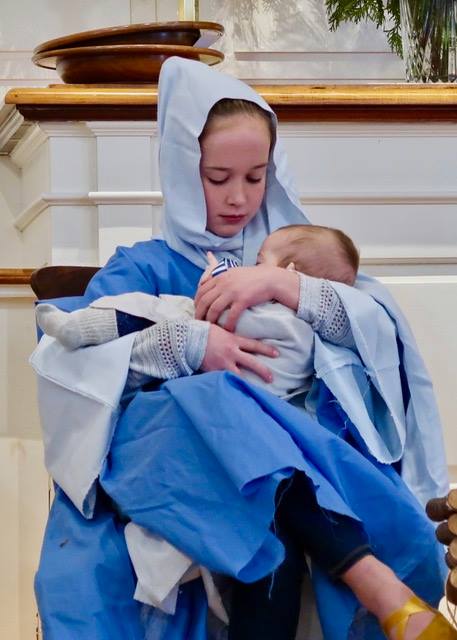
This year, the 10-year-old girl playing Mary and the 3-month-old baby playing Jesus happened to be brother and sister.
And after that moment of breathless uncertainty during the hand-off, it became evident that this young girl knew how fragile and precious this particular baby was, just in the way she held him and rocked him and gazed into his eyes.

When we enlist a real baby in the telling of the Christmas story the stakes suddenly become much higher – and the revelation that this baby is a precious gift becomes much more apparent.

But all babies are a precious gift –
what makes this particular baby born some 2000 years ago so special?
This baby is special, because this baby represents God’s desire to live in relationship with us.

We are finite creatures made of stardust and earthdust.
We have limited senses, perceptions, and intellects.
We are prone to mistakes, missteps, and misinterpretations.
We often are incapable of truly seeing –
unless something is right in front of us –
and even then we may dismiss, deny, or disbelieve that it’s even there.

To live in relationship with a creature like us is a challenge indeed.
We struggle to do it even amongst ourselves.

But our God can’t help but take on that challenge.
As the Creator longs to connect with its creation.
Just as creation longs to connect with its Creator.

So God became one of us.
To know what it is to wear skin and muscle and bone and move on the earth.
To know what it is to feel joy and disappointment, excitement and despair, fulfillment and rejection.
To know what it’s like be limited – and loved -
to be swaddled and placed in a manger, looking up and out,
at a world that is full of sharp points, jagged edges, and rocky landings,
but is also full of warm embraces, healing hands, and tender hearts.

The gift in the manger is that God became one of us so that God would better know us, and so that WE would better know God.
So we would know unending grace, limitless compassion, and unconditional love.
Not just in a “read about it in an ancient book” kind of knowing.
But in a seeing – feeling – hearing – touching –  
experiencing it for ourselves - kind of knowing.

Whatever you believe about Jesus –
Whomever he is to you –
Whether God-filled, God-inspired, or God incarnate.
He left his mark on our world in a way that has us still talking about him 2,000 years onward.
His teaching, his touching, his way of getting under our skin with his pointed tales about loving enemies, forgiving persecutors, and giving it all away – wealth, power, privilege – so that the least among us will also experience a life of abundance as God intended it to be.

Jesus embodied what it means to love kindness, to act justly, and to walk humbly with our God.
Jesus embodied what it means to be a vessel for unending grace, limitless compassion, and unconditional love –
- a vessel that continuously empties onto and into others.
Jesus embodied what it means for Creation to live in relationship with itself and with its Creator.

So every year, we celebrate his birth.
The silent night that he came into our world and set about connecting us to one another.
Teaching us how to be the presence of God for one another.
Showing us how to dull the sharp points and smooth the rough edges and create softer landings for one another.

Now, if this talk of softer landings conjures up images of helicopter parents or nervous nannies who wish to rid the world of all its hardness…
Know that this is not about removing all the challenges, difficulties, and uncertainties that push us and stretch us to be more than what we are.
The sharp points and rocky landings will always be there –
that’s the nature of our world.
The message that Jesus has for us is that the world presents enough challenges on its own without the need for us to contribute to it.
Instead, we’re called to be the presence of Christ for another -  
to lighten the load and lessen the blows in any way that we can.

To be shown how to do such a gracious and loving thing for others –
and experience it for ourselves –
This truly is an unexpected gift. 

The gift in the manger is precious.
It’s a gift we didn’t think to ask for, and didn’t realize we longed for,
until it was given to us.

It’s the gift of God showing us what it is to live into the image of our Creator.
It’s the gift of knowing that our God does not stand apart from us in our human experience – but knows that experience first hand –
and is with us in it.

The Christmas story invites us to reconnect with this precious gift,
and to lift up thanks for it, year after year.

The Christmas story invites us to hold this precious gift in our arms –
to marvel at its power and its fragility –
and to then hand it off to someone else.
Even as others gasp at the trust that it takes to do so.

My prayer for all of you on this Christmas Eve,  
is that when you peer into the manger,
you will find this unexpected gift waiting for you.

This gift of healing and hope, this gift of joy and peace,
This gift of presence…and love.
This gift of relationship with our God.

Merry Christmas to us all…and Amen.


Sermon: "An Expectant Time"


Scripture Intro - Luke 1:39-55

This passage from Luke’s Gospel contains the text of one of the earliest Christian hymns to be sung in worship.
It is the Song of Mary – otherwise known as the Magnificat.
These are the words of praise that Mary lifted up when she visited her much older relative, Elizabeth, to tell her that she too was expecting a child.
Elizabeth was pregnant with John, and Mary was pregnant with Jesus.
Both women in their own way were called upon to prepare the way for God to enter into our world.
On this fourth Sunday of Advent, the words of these women capture the impending joy that we feel as we too prepare a way for Jesus to enter into our world.


The Rev. Maureen R. Frescott
Congregational Church of Amherst, UCC
December 23, 2018 – Fourth Sunday of Advent
Luke 1:39-55

“An Expectant Time”

Earlier this week, we had a few windows replaced in the parsonage next door.    It was 22 degrees outside and the wind was gusting at 22 mph.
In other words, a perfect day to replace windows.
As one of the workmen stood in our family room and removed the old window from its frame, he looked out at the church next door and said,
“It’s a beautiful church…and so needed. People need God now more than ever – especially with the way things are in the world today.”

My immediate thought was – “There’s a sermon in there.”
Initially, I was drawn to the first part of what this insightful craftsman said – “People need God now more than ever.”

I admit that I’m biased, but I tend to believe that people always need God, even if they don’t always realize it…but the Christmas season is a wonderful time to remind ourselves of the role that God plays in our lives –
in the good times and the difficult times.
To remind ourselves that Jesus is Emmanuel – God with us – in all times.
But as I sat all week with these words of wisdom uttered by this installer of windows on the world, as he looked out at our church framed against a blustery Advent sky,
I found myself drawn more to the second part of what he said: 
“People need God now more than ever -
“…especially with the way things are in the world today.”

This is something we’ve heard quite a few people say lately.
We may have even said it ourselves.
That somehow THIS TIME that we’re living in seems to be worse than times that have come before.
That the world around us seems to be more turbulent and less safe,
the people around us seem to be less respectful and more antagonistic,
and the outlook for the future seems to be less hopeful and more grim. 

We all know that time is relative.
As is our perception of what is happening in any given time.
Not just in an Einstein – Theory of Relativity kind of way,
but in the way we perceive and experience the world from our varying perspectives and our varying points in time.

If we lived 1,000 years ago, in the midst of the dark ages that followed the fall of the Roman Empire, when the average life expectancy was only 30 years of age; that time may have seemed like the worst of times.

If we lived 500 years ago, in the midst of the bloody religious wars between the Catholics and the Protestants and in the aftermath of the Crusades and the bubonic plague, that time may have seemed like the worst of times.

If we lived 100 years ago, when the first Great War caused food and resources to be rationed, a worldwide flu epidemic claimed 50 million lives, and seeds were being sown for the Great Depression and the rise of Adolph Hitler, that time may have seemed like the worst of times.

And if we lived 50 years ago, when social norms involving sex, drugs, religion, and authority were beginning to break down,
when those protesting against war or for civil rights were shot in the streets or assassinated for their beliefs,
when an energy crisis had people sitting in mile long lines to buy gas,
and the world’s super powers had us locked in the grip of the cold war,
that time may have seemed like the worst of times.

Any time can seem like the worst of times when we’re the ones living in it.
Admittedly, much of our perception about this time being worse than the time before, has less to do with what happened 100 or 1000 years ago and more to do with the perceived changes we’ve seen in our own lifetimes.

And we must also admit, when we place our focus on the things that we feel have gotten worse we tend to overlook the things that have gotten better –
like the advancements in modern medicine, the technology that allows us to house, feed, inform, and care for more people than ever before,
and the widening circle of inclusion that lifts up the voices and grants equivalent status to people of all colors, genders, sexual orientations, abilities, and ages.
In this regard, the world has changed drastically – for the better – from what it was even just ten or twenty years ago.

Making a comparison between the circumstances and events of other times is in no way meant to dismiss or diminish the very real pain and sense of despair that is felt by those in our time.
As we’ve said, every time and experience is relative.

What this comparison in time helps us to do is to connect us back to Mary and Elizabeth.
The mother of Jesus and the mother of John the Baptist.
Who lived in a time that to them seemed like the worst of times.
First century Palestine.
When the Roman Empire ruled over the people of Israel.
When there was no such thing as a middle class,
and you were either part of the less than .01% who were very rich,
or part of the 99.9% who were very poor.
When a child conceived in either a peasant family like Mary’s or a more well-off priestly family like Elizabeth’s, was not likely to survive the pregnancy, let alone the birth, or the first few tender years of life.

Yet Elizabeth and Mary seemingly set these very realistic worries aside,
and believed the heavenly host who told them their sons would not only live, they were each destined to play a part in the fulfillment of God’s promise to the world – the promise that everything could and would change for the better.

The angelic visit aside, we may wonder what crystal ball Mary must have been looking into when she sang about God’s great accomplishments in the Magnificat we have preserved in Luke’s Gospel.

You may have noticed that for most of the song Mary sings not in the future tense, but in the past and present tense:
“God has scattered the proud in the thoughts of their hearts.
He has brought down the powerful from their thrones, and lifted up the lowly;
he has filled the hungry with good things, and sent the rich away empty.”

This certainly wasn’t the case in Mary’s time.
In her time the powerful were still very much seated on their thrones.
The hungry were anything but filled.
And the rich were rarely if ever sent away empty.

So what was Mary singing about?
Was she describing some future world that was yet to be but that she saw as clear as day as if it already existed?
Likely.
Biblical prophets had a habit of not seeing time in a linear way.
As author and scholar, Barbara Brown Taylor, points out –
“Prophets almost never get their verb tenses straight, because part of their gift is being able to see the world as God sees it”
– They don’t see the world divided into successive time periods labeled as “things that have already happened” and “things that have not yet happened”,
Instead, they see God’s world “as an eternally unfolding mystery" that is both yet to come and already here.

Now, if your brain is starting to hurt after all this talk about time being relative, or non-linear, with the past, present, and future all happening at the same time, you’re not alone.

Personally, I love stories that involve movement through time –
whether it’s a science fiction story about time travelers who jump ahead into the future or back into the past – like the Dr. Who TV series, or the classic HG Wells novel, the Time Machine,
or a story of a single family that unfolds over multiple-generations and takes us forward and backward, connecting events and people through time – like Alex Haley’s mini-series “Roots,” or the current NBC show, “This is Us.”

There’s something captivating about seeing the events of the past, present, and future come together, as their convergence allows us to find patterns and trace the connecting strands that weave their way through our time.
We might note how a choice made by one person in the past carries through to the life of another in years to come, and how looking ahead in hope to a much-different future, influences choices made here in the present.

Mary and Elizabeth may not be much different from most mothers in our time, as they rest their hands on their bellies and imagine a future for their child that is filled with meaning, purpose, and joy.
Regardless of economic or social circumstances, most expectant mothers can’t help but hope that their yet to be born child will have a better life in the future than the one they are living in the present.
One that has decidedly less pain and hardship,
and more opportunities for joy and fulfillment.

Mary’s song for her child, and Elizabeth’s longing for hers, is the anticipation of the fulfillment of God’s promise to humanity.
It’s not about looking back and saying,
“Things are so much worse now than they were before” –
It’s about looking ahead, and saying, “Things will be so much better –
and already are so much better than they were before,
because of the promise of what is to come.”

Advent is about looking ahead to what has the potential to be.
Advent is about resting in that hope for the future – and using it as a light that illuminates and warms and shapes the present.

In many ways, Advent is a description of faith itself.
Because so much of faith is about anticipation.
Anticipation that leads to response.
Response that changes the present to look like the future we hope to come.


On this fourth Sunday of Advent, on the Eve of Christmas Eve,
May we not be so quick to move past this expectant time,
and into the busyness and activity and fulfillment of Christmas Day.
But instead give ourselves space to be present in this time –

Where Mary and Elizabeth are still mother’s to be, 
And sing as if their children have already walked this earth.
Where Jesus is Emmanuel – God with us –
and is both coming into this world and already here.

Where the hopeful future we imagine for the children yet to come
is both anticipated, and already present,
in our actions
and in our hearts
and in our time.

Thanks be to God, and Amen.